At the core of the NEOLAiA project lies Work Package 1 (Project Management). This work package ensures the smooth functioning of the alliance by overseeing its coordination, legal framework, quality assurance, and strategic alignment among the nine partner universities. WP1 plays a key role in shaping NEOLAiA’s future as a resilient, efficient, and inclusive European University.
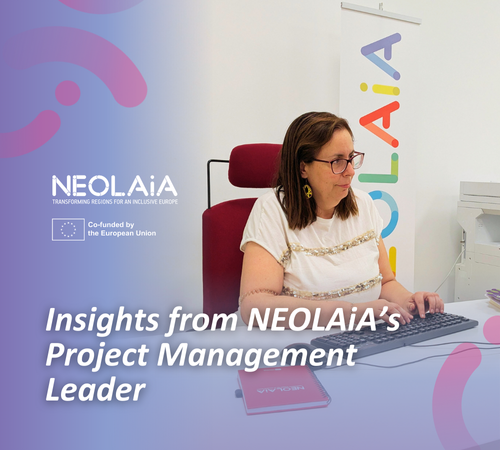
We sat down with the leader of Work Package 1 Beatriz Valverde Jiménez to discuss the challenges, strategies, and vision that drive the alliance forward. From fostering collaboration and reducing administrative burdens to piloting legal innovations like the Key and Human Resources Hub, WP1 is paving the way for sustainable transnational cooperation.
Read the full interview below to learn how governance is transforming NEOLAiA from a project into a lasting institution.
Can you introduce Work Package 1 and its main responsibilities within the NEOLAiA Alliance?
Work Package 1 (WP1) lies at the heart of NEOLAiA’s structure, overseeing project management and governance across the alliance. As the coordinating body, WP1 is responsible for ensuring strategic alignment among the nine partner universities and monitoring progress against the project’s goals. It also leads efforts in reducing administrative burdens and increasing efficiency. WP1 act as a bridge between partner organizations, uniting independent functions within each of them to ensure activities are coordinated, communication flows, decisions are made, and resources are utilized optimally to achieve the alliance’s goals. Through this framework, WP1 guarantees that NEOLAiA evolves as a truly integrated and internationalized European University.
Why is project management crucial for the success of NEOLAiA?
Effective project management is essential to NEOLAiA’s ambition of becoming a model European University. With activities spanning mobility, teaching, research, diversity, and entrepreneurship, the alliance requires robust coordination mechanisms to synchronize efforts. WP1 ensures that activities across all work packages are coherently planned and implemented, aligning them with European policy goals. The centralization of strategic oversight through WP1 allows NEOLAiA to act as a blueprint for cross-border academic cooperation.
What are the key activities and tasks that WP1 oversees?
WP1 oversees a broad range of activities that include setting governance structures, facilitating strategic decision-making, monitoring implementation, and managing risks. It coordinates the work of the other WPs, ensuring consistency and coherence across thematic. In addition, WP1 is responsible for studying options and piloting the KHRH, a legal entity that embodies NEOLAiA’s commitment to efficient, transnational operations.
How does WP1 ensure smooth coordination between the different work packages and partner universities?
WP1 acts as the main communication and decision-making channel, aligning the strategic direction of NEOLAiA with the operational efforts of its partners. It does this through regular steering meetings, transparent reporting tools, and a digital project management infrastructure. By fostering a culture of collaboration and accountability, WP1 enables synergy between work packages and ensures that all partner universities contribute effectively, regardless of their national contexts or institutional differences.
What are some of the main challenges WP1 faces in managing a transnational alliance like NEOLAiA?
Managing a transnational alliance like NEOLAiA comes with unique challenges, including cultural differences, administrative discrepancies, and varying national regulatory environments. WP1 must navigate these complexities while maintaining a shared vision and unified strategy. One of the most significant challenges is harmonizing workflows and processes across institutions, which WP1 addresses through shared governance tools and by promoting mutual trust and continuous dialogue.
How does effective project management contribute to achieving NEOLAiA’s long-term goals?
Effective project management directly contributes to NEOLAiA’s long-term objectives by providing the stability and direction needed to sustain innovative actions beyond the current funding period. By embedding strategic foresight into all processes, WP1 ensures that efforts in regional development, digital transformation, and joint educational programming can be scaled and sustained.
What strategies does WP1 use to ensure transparency and efficiency in decision-making?
Transparency is a core principle of WP1’s governance model. Decision-making is supported by clear reporting mechanisms, open access to progress metrics, timeline to advance in the resolution of crucial issues and an inclusive structure that incorporates input from all partner universities. These practices reduce bureaucratic overhead and foster trust among stakeholders.
How does WP1 support the sustainability and growth of the Alliance beyond the current funding period?
WP1 is instrumental in ensuring that NEOLAiA remains resilient and impactful after the current funding cycle. By institutionalizing the alliance’s practices through legal and digital frameworks, WP1 lays the foundation for long-term cooperation. It also supports initiatives that generate lasting value for regional development and higher education. These initiatives contribute to the EU’s goals of creating “regional innovation valleys,” enabling NEOLAiA to have a sustained impact on its communities.
In addition, the Sustainability and Financial Plan, which is central to ensuring the alliance’s continuity, is developed and updated annually with direct involvement from consultative bodies introduced in WP1 Task 1.2, namely the EAB (External Advisory Board), SRTAG (Staff, Researchers and Teachers Advisory Group), and SAG (Student Advisory Group). These bodies provide strategic input, ensuring that the alliance remains relevant, adaptable, and responsive to stakeholder needs.
How does WP1 foster collaboration between the different partners?
WP1 fosters interaction between partners via joint training programs, shared mobility initiatives, and transnational project groups. It emphasizes the importance of building trust and mutual understanding, which is critical when co-developing tools for open science, diversity and inclusion standards, or transnational teaching modules.
Are there any best practices or lessons learned from WP1 that could be useful for other European Universities Alliances?
NEOLAiA’s WP1 offers valuable insights for other European University Alliances. NEOLAiA is part of FOREU4ALL and the group of UEUE (Spanish Universities in European Universities, in its acronym in Spanish), beneficing of the knowledge of other European and national Universities and contributing to these groups with our best practices. As an example, WP1 members in NEOLAiA keep a close contact and helps implement initiatives that comes from the student bodies of the different universities. It is key for the sustainability of Alliances that internal and external stakeholders feel NEOLAiA as their home apart from their own institution, and supporting students in implementing initiatives they are interested in helps in that sense.
What are the upcoming priorities or goals for WP1?
Looking ahead, WP1 will try to focus on consolidating NEOLAiA’s governance mechanisms, refining its legal and digital infrastructure, and deepening interregional complementarity. The priorities include scaling up successful pilot projects, further harmonizing administrative practices, and ensuring that NEOLAiA can secure new sources of funding. WP1 will also play a key role in institutionalizing new joint/multiple bachelor’s and master’s degrees and mobility schemes developed during the initial funding period.
How do you envision the future of NEOLAiA, and what role will WP1 play in shaping it?
NEOLAiA envisions a future where it serves as a guide mark for regional engagement, cross-border academic cooperation, and institutional innovation. WP1 will remain at the centre of this vision, anchoring the alliance’s strategic goals and driving its transformation into a sustainable, legally robust, and socially impactful entity. By enabling synergies across mobility, research, and inclusion initiatives, WP1 will continue to be adaptive, and aligned with the Europe’s evolving educational and regional needs.
**
Funded by the European Union. Views and opinions expressed are however those of the author(s) only and do not necessarily reflect those of the European Union or the European Education and Culture Executive Agency (EACEA). Neither the European Union nor EACEA can be held responsible for them.