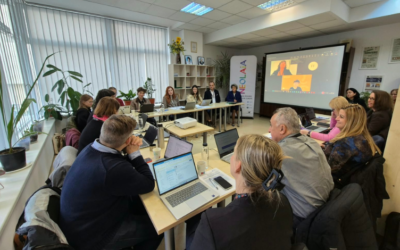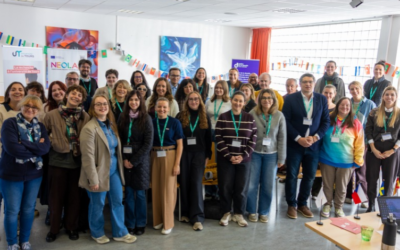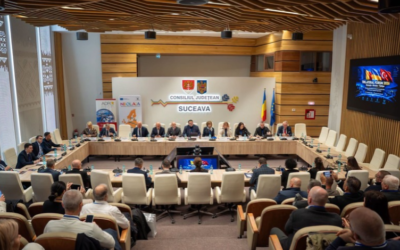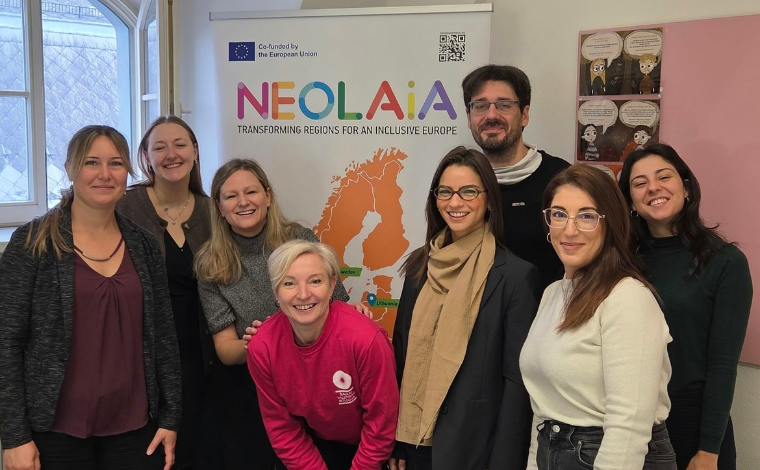
On 12 and 13 October, the NEOLAiA Expert Team for Staff Training met at the University of Ostrava to consider how these exchanges could reach more colleagues across the Alliance. The discussions focused on opening selected training activities beyond the existing networks and developing an offer that partner universities can sustain alongside their other responsibilities.
The meeting brought together coordination team representatives from the University of Nicosia, the University of Salerno, the University of Tours, Šiaulių valstybinė kolegija and the University of Ostrava. Wellbeing experts from Bielefeld University also participated, contributing their experience to the discussions. During their visit, they met separately with human resources specialists at the University of Ostrava to exchange experience outside the staff training programme.
Building on the experience of staff networks
The Expert Team for Staff Training coordinates Task T4.3, which supports professional learning and exchange among non-academic staff. Its work draws on the expertise available across the nine NEOLAiA universities, with each institution contributing to a network in a particular professional field.
Together, these networks cover communication, academic support, responsible internationalisation, libraries and open science, wellbeing, student services, career counselling, language skills, and strategy and evaluation. They give colleagues a way to discuss the practical questions that arise in their daily work and to see how similar services are organised elsewhere.
Some networks have already brought their members together in person. The Academic Support Officers and PR networks have organised Staff Weeks, while the Responsible Internationalisation Network has held an in-person meeting. Alongside these activities, networks have been developing opportunities for online learning and exchange.
Progress has varied between networks, reflecting differences in their circumstances and available resources. Staff turnover and changes within the coordination team have also affected continuity. The meeting in Ostrava gave participants time to take stock of this experience, discuss the difficulties they had encountered and agree on a manageable approach for the next semester.
Making room for colleagues beyond the networks
One of the main agreements concerned who can take part in training. Until now, activities have largely been available to members of the respective professional networks. While these groups provide a useful setting for exchanges between specialists, some of the subjects they address are relevant to a much wider range of university staff.
The team therefore agreed to make selected workshops, webinars and training sessions available to colleagues outside the networks. The intended audience will depend on the subject and the skills being developed.
English-language learning is one example of an activity that can be useful across departments and professional roles. Opening such sessions more widely would allow colleagues to benefit from the Alliance’s training offer without first becoming members of a particular network. At the same time, the networks will continue to provide a space for more specialised discussions and ongoing cooperation.
The team also considered how to encourage participation and explain the benefits of the offer. Depending on the activity, communication will focus either on inviting colleagues to join a relevant network or on reaching staff across university services.
An offer that reflects what partners can deliver
Providing training across nine universities requires an approach that takes different capacities into account. Organising a Staff Week involves a different level of preparation and resources from delivering a single online workshop, and partners cannot all contribute in the same way.
In Ostrava, the team agreed that each university should build its contribution around what it can realistically offer. For some, this may be a Staff Week or a Blended Intensive Programme. Others may contribute individual training sessions, scheduled activities for groups of staff, or online learning opportunities.
This flexibility allows the programme to draw on expertise across the Alliance while keeping the workload manageable for those organising it. Contributions can vary in scale and format, with each university taking part according to its resources.
Participants also discussed giving selected activities a more regular place in the programme. Workshops, seminars and webinars on skills relevant to different staff groups could be repeated each semester. Recurring sessions would give colleagues further opportunities to participate when the timing of an earlier activity did not suit them.
Giving staff time to plan
The team set mid-November as the target for preparing a concrete programme for the following semester. Once contributions have been confirmed, the focus will move to promoting the activities to the relevant staff groups.
Earlier announcements will be part of this process. In-person and blended activities must be publicised at least four months in advance, while online activities must be announced at least one month beforehand. These lead times are intended to give colleagues enough time to consider the opportunity, discuss their participation at their institution and make any necessary arrangements.
The work following the Ostrava meeting will focus on turning the partners’ contributions into a clear training programme. For staff across NEOLAiA, this should make it easier to find relevant opportunities, plan their participation and learn from colleagues whose experience can inform their own work.