The UJA celebrated its “NEOLAiA Alliance Week” with the launch of its new website, designed to promote the consortium’s opportunities
The Vice-Rectorate for Internationalisation organised an extensive programme of activities in Jaén and Linares with the aim of creating a space for the dissemination and promotion of the European alliance’s activities and new initiatives.
From 17 to 21 November, the University of Jaén celebrated “NEOLAiA Alliance Week”, promoted by the Vice-Rectorate for Internationalisation, with the aim of providing a space for dissemination, promotion, awareness-raising and community building among those who have participated or are participating in the activities of this alliance (coordinated by the UJA and with total funding of €14.4 million) and those who wish to join this new phase.
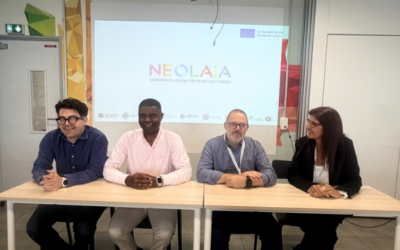
The conference began with the presentation of the alliance’s new internal website, which was browsed by the Rector of the University of Jaén, Nicolás Ruiz, together with the Vice-Rector for Internationalisation, José Ignacio Jiménez, and the Director of the Secretariat for European Universities, Beatriz Valverde. “This new website is designed to effectively, quickly and systematically publicise all the opportunities offered by the NEOLAiA project and the alliance itself, through its institutions,‘ said José Ignacio Jiménez, explaining that it is a website ’designed to openly promote the various opportunities offered by the alliance to each of the university community groups and to disseminate activities in an agile and transparent manner,” thus contributing to the construction of the transnational campus that NEOLAiA represents and which aims to transform universities and make them more international, more global and more diverse, ‘to prepare our students, our teaching and research staff (PDI) and our technical, management and administration and services staff (PTGAS) for the challenges and opportunities of the future’.
Conference programme
After the presentation ceremony, the conference continued with a round table discussion with NEOLAiA partner organisations entitled “NEOLAiA and the territory. Innovation, inclusion and talent to respond to regional challenges”, in which Antonio Castillo, head of the European Projects Section of the Provincial Council of Jaén, and Elena Sánchez, director of the Technology Department at Macrosad, participated. This was followed by the presentation of the NEOLAiA Alliance’s White Paper on Language Policy by María Luisa Pérez Cañado, leader of the work package “Towards a multilingual and intercultural European university”. Finally, the opportunities for the PTGAS within the NEOLAiA framework were discussed.
The conference continued on Tuesday, analysing opportunities for the PDI within the NEOLAiA framework. This was followed by the launch of the “NEOLAiA Open Science Hub”, with the participation of Bienvenida Gilbert López, delegate of the NEOLAiA Alliance’s Open Science Work Package. The day was rounded off with talks on “Open Science at the UJA Library” by its director, Sebastián Jarillo, “Citizen Science at the UJA” with the participation of Alicia Barea from UCC+i, and the presentation of the Andalusian Citizen Science Office, with a networking session involving Teresa Cruz and Silvia Alguacil from the Descubre Foundation.
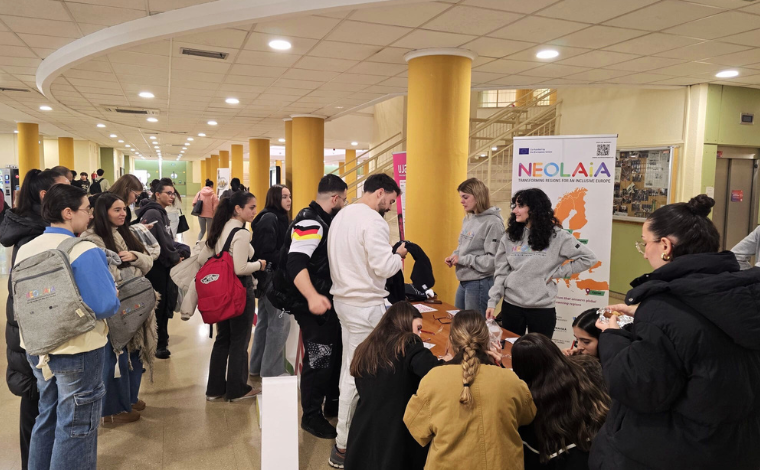
Wednesday’s activities focused on UJA students, who were able to learn about what the Alliance has to offer through various information stands located in Lecture Halls B4 and A4, where they could also visit a photo exhibition on the universities and cities that are part of NEOLAiA.
On Thursday, student testimonials and PDI experiences related to NEOLAiA were shared, the activity “Creating the NEOLAiA community” was held, consisting of a space to bring together those who are already part of the experience and those who wish to get involved, and a special UniRadio programme was broadcast with the protagonists of the week.
Finally, on Friday 21st, the activities moved to the Linares Campus, where the possibilities and opportunities offered by NEOLAiA were discussed again and “Citizen Science” was revisited.
**
Funded by the European Union. Views and opinions expressed are however those of the author(s) only and do not necessarily reflect those of the European Union or the European Education and Culture Executive Agency (EACEA). Neither the European Union nor EACEA can be held responsible for them.