How can European University Alliances build stronger communities and create a genuine sense of belonging among students, staff, and local stakeholders?
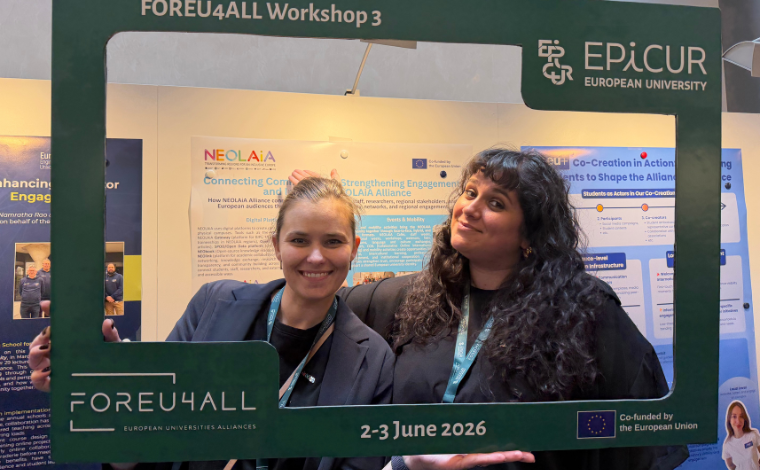
These questions were at the heart of the FOREU4ALL Workshop 3: “From Campuses to Communities”, which brought together representatives of 58 European University Alliances at the European Parliament in Strasbourg, France, on 2–3 June 2026.
Representing the NEOLAiA European University Alliance were Gina Zdanavičienė, NEOLAiA Project Communication Manager, and Claire Durand, delegate of the Improving Teaching and Learning and Enhanced Mobility work packages. Together with more than 130 participants attending onsite and over 120 participants joining online, they contributed to discussions exploring how alliances can strengthen community engagement, increase participation, and create lasting connections across Europe.
Building Communities Beyond Institutional Boundaries
Throughout the workshop, participants exchanged experiences and good practices related to communication, community building, student engagement, and alliance visibility.
One recurring theme was the importance of creating an emotional connection between alliance members and their European university communities. Participants highlighted that students and staff often struggle to develop a sense of belonging due to limited awareness of alliance opportunities, competing academic workloads, and insufficient involvement in alliance activities.
Several alliances shared inspiring examples of successful engagement initiatives. Representatives from EUT+ presented their dissemination strategy, which encourages researchers to publish their outputs under a shared European identity. Originally aiming for 100 research uploads by 2027, the alliance has already surpassed 300 contributions after only one year, demonstrating the impact of a clearly communicated collective vision.
The alliance also showcased creative visibility initiatives, including city buses carrying alliance branding, helping students feel connected to their European university community even while away from their home institutions.
Student Voices at the Centre of the Conversation
Student representatives played a prominent role throughout the workshop, offering valuable perspectives on participation and belonging.
Discussions highlighted practical barriers that often prevent students from engaging in alliance activities, including financial concerns and delays in mobility reimbursement processes. Students also noted that expectations placed upon them can sometimes feel overwhelming, particularly when opportunities and responsibilities are not clearly communicated.
Participants emphasised that meaningful engagement requires more than simply appointing student representatives. Successful examples presented during the workshop included student ambassador programmes, involvement in International Weeks and Blended Intensive Programmes (BIPs), participation in thematic working groups, and student-led initiatives that give learners genuine ownership of alliance activities.
A key message emerging from the discussions was that engagement grows when students are given agency and can actively shape the alliance rather than merely participate in activities designed for them.
Learning from European University Alliances
The workshop also encouraged reflection on broader questions facing European University Alliances. Participants explored how alliances define and promote European values, how community engagement strategies should be developed, and how institutions can ensure that decision-making processes genuinely reflect bottom-up approaches.
Several speakers stressed that community engagement strategies must be visible and understandable to all members of the alliance community. Students, academics, and professional staff should clearly understand the alliance’s mission, opportunities, and long-term goals if they are expected to become active contributors.
Another important takeaway was the value of intercultural exchange. Participants highlighted how alliances create unique environments where individuals can communicate across languages, share cultural perspectives, and develop a deeper understanding of Europe through everyday collaboration.
The workshop concluded with the presentation of twelve collaborative prototypes developed by participants, demonstrating the collective commitment of European University Alliances to strengthening their communities and increasing engagement among students and staff.
For NEOLAiA European University Alliance, participation in FOREU4ALL provided an opportunity not only to share experiences and good practices but also to contribute to shaping future approaches to community building within the European Universities Initiative. The discussions reinforced the importance of communication, visibility, student empowerment, and shared values in creating vibrant and connected European university communities.